


Translational neurosurgery for movement, epilepsy, pain, and stroke recovery.
Computational, engineering, and statistical methods applied to intraoperative neurophysiology — to inform surgical planning, neuromodulation, and brain computer interface design.
Patients: request an appointment — 800-789-7366
A translational research lab in functional and stereotactic neurosurgery.
The RESToRe Lab records the electrical activity of the brain and spinal cord, and uses maths, engineering and computing to make sense of it. That work helps us plan operations, find new places in the brain worth stimulating, and understand how the brain controls movement — so that function can be restored after injury to the nervous system. We work across movement disorders, epilepsy, pain and stroke.
I'm a patient or family member.
Plain guides to the conditions we treat — movement disorders, epilepsy, pain, and recovery after stroke. How to get referred, and what happens at your first visit.
Patient information →I'm a researcher, clinician, or student.
Our research: four clinical areas — movement, epilepsy, pain and stroke recovery — and two sets of tools that run through all of them. Plus papers, software, and open positions.
Research areas →Four clinical areas, two shared methods, one translational program.
The four clinical areas are the conditions we treat and study. The two methods sit underneath all four: the same recordings and the same software, used on different diseases.
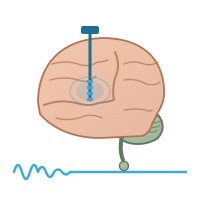
Movement disorders
Recording brain activity during awake DBS surgery for Parkinson's disease and essential tremor. Also scan-guided DBS, focused ultrasound for tremor, and early work on cerebellar DBS for cerebral palsy.
Research →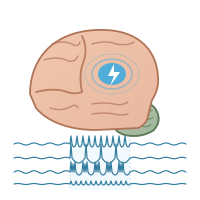
Epilepsy
Depth recordings to work out where seizures start, and measures that may mark the spot more reliably. We also track how people do years after laser treatment for temporal lobe epilepsy.
Research →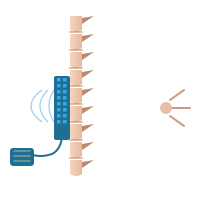
Pain & neuromodulation
Surgery for pain that has not responded to other treatment, and devices that adjust themselves in response to the brain.
Research →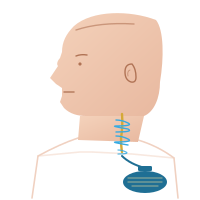
Stroke recovery
A nerve stimulator paired with intensive therapy, for arm and hand weakness that lingers after a stroke. Approved in 2021 and offered at Penn as treatment, assessed together with the stroke and rehabilitation teams.
Research →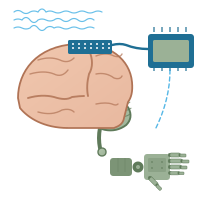
Brain computer interfaces
Fine-grained recording from the brain and spinal cord during planned surgery, and implanted devices meant to give back hand grip after spinal cord injury.
Research →
Computational methods
Open-source tools the rest of the lab runs on — Thalamus for real-time closed-loop data capture, nSTAT for point-process and time-series analysis of neural data.
Research →What's new in the lab.
The most recent confirmed activity. Filterable feed at news.
Min Jae Kim presents STN-DBS effects on motor cortex and cortico-basal ganglia connectivity at AANS.
MD–PhD candidate Min Jae Kim presented a rapid-fire oral abstract at the American Association of Neurological Surgeons (AANS) Annual Meeting on how subthalamic-nucleus deep brain stimulation modulates microscale motor …
Read on news →Pedro Borges leads a preprint on microscale organization of the human motor homunculus.
Drs. Iahn Cajigas, Bijan Pesaran, Casey Halpern, and colleagues (including Drs. Liming Qiu, Michael Beauchamp, and Daniel Yoshor) report new findings on the microscale organization and separability of upper-extremity …
Read on Research Square →Bowen Wang submits master's thesis on single-hemisphere bimanual decoding for motor brain–computer interfaces.
Master's student Bowen Wang submitted his Penn Bioengineering M.S.E. thesis, "Single-Hemisphere Decoding of Bimanual Hand Movement: Implications for Motor Brain-Computer Interfaces." The work spans a Miami chronic …
Read on news →NIH K12 Neurosurgeon Research Career Development Program · Michael J. Fox Foundation · Vazirani Fund for Spinal Cord Research.
Primary collaborators include Dr. Bijan Pesaran (Brain Machine Interface Systems Lab), Dr. Michael Beauchamp (Beauchamp Lab — multisensory integration and visual perception), and Dr. Casey Halpern (Stereotactic and Functional Neurosurgery, Halpern Lab).