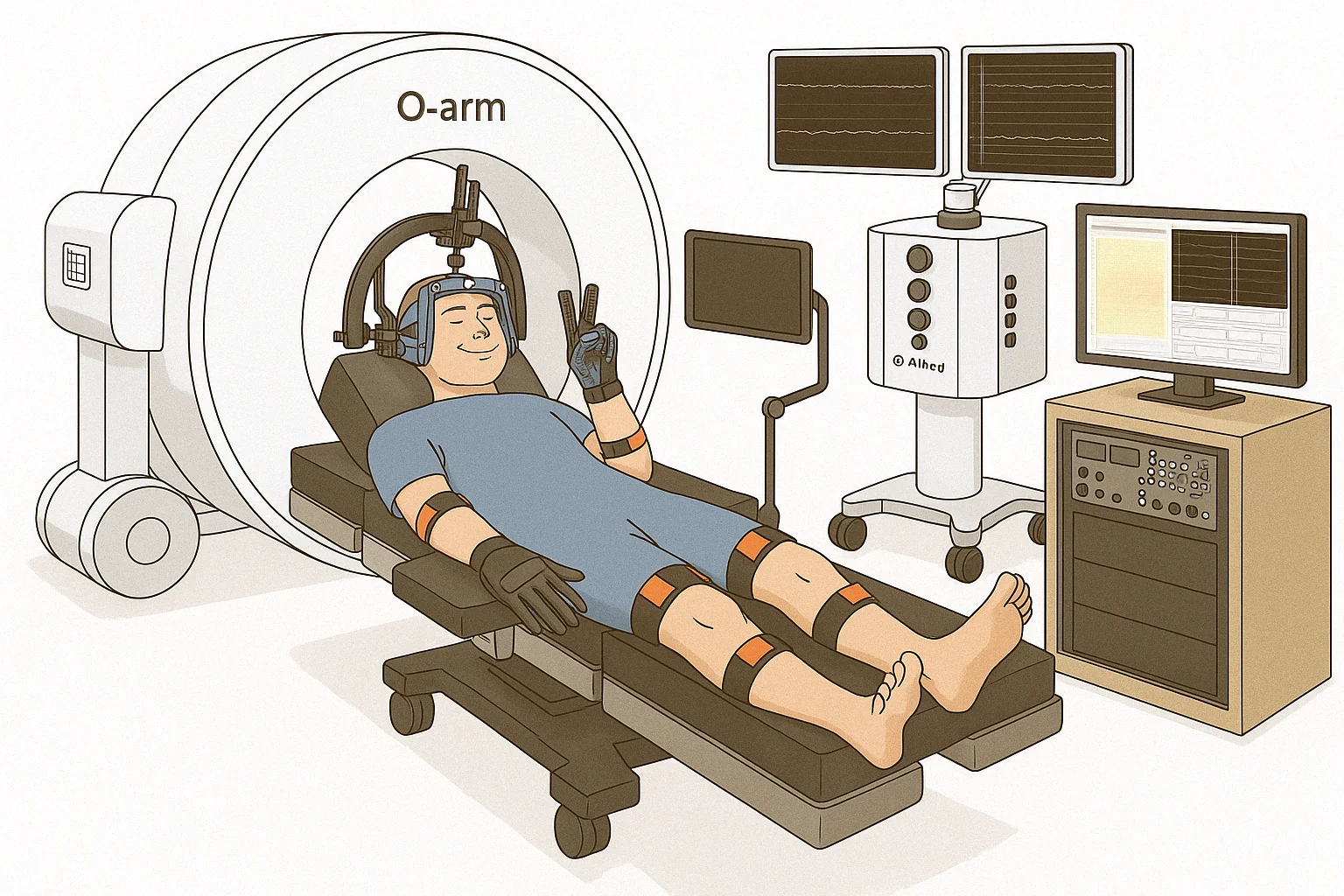


Movement disorders — intraoperative neurophysiology during awake deep brain stimulation (DBS).
The lab records single-unit and local-field-potential activity during awake DBS implantation for Parkinson's disease and essential tremor, and uses high-density ECoG arrays in collaboration with Precision Neuroscience.
Work threads:
- Imaging-guided directional DBS for Parkinson's disease and essential tremor.
- Cuneiform-nucleus DBS for levodopa-resistant freezing of gait — Phase I pilot, multicenter trial supported by the Michael J. Fox Foundation.
- MRgFUS for tremor (essential tremor, parkinsonian tremor).
- Cerebellar DBS for movement disorders in cerebral palsy.
// What we have found so far
- Three patients aged 14 to 22 with dyskinetic cerebral palsy had stimulating electrodes placed on both sides of the cerebellum, in a part called the dentate nucleus. All three came through the surgery well. Their scores on a standard movement scale improved by 19% to 40%. The authors say the approach looks safe and may help, but that larger studies with longer follow-up are needed before anyone can be sure. Cajigas et al., J Neurosurg 2023 DOI
- A review paper argues that a small area of the brainstem called the cuneiform nucleus may be a better place to stimulate for freezing of gait than the site tried before, where trials disappointed. This is the reasoning behind the current trial. It is a review of existing work, not a result in patients. Chang, Cajigas et al., Front Syst Neurosci 2020 DOI